
Cantilever Shadeport Installation in Cape Town
Create more usable space, enhance your property’s appearance, and shield your vehicles from Cape Town’s harsh sun, wind, and weather with professionally installed cantilever shadeports.
No front posts
Full vehicle access
Wind-engineered for Cape Town
Cantilever Shadeport in Cape Town
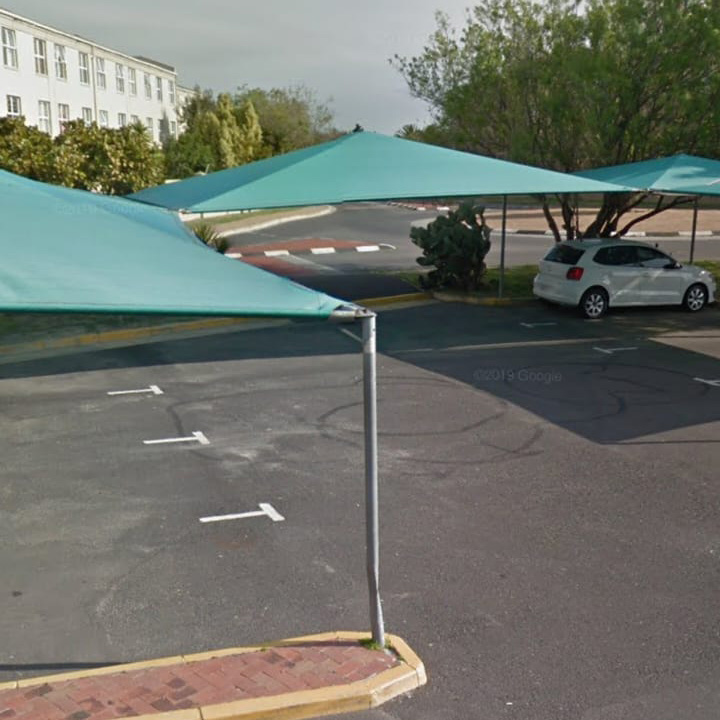
A cantilever shadeport has posts on one side only. The roof extends out over the parking bay, with nothing in the way on the access side; no corner posts to drive around, no obstacle at your garage door, no compromise on a narrow driveway.
Crown Shadeports designs and installs cantilever shadeports across Cape Town. Single, double, and multi-bay configurations. Engineered for Cape Town’s wind conditions.
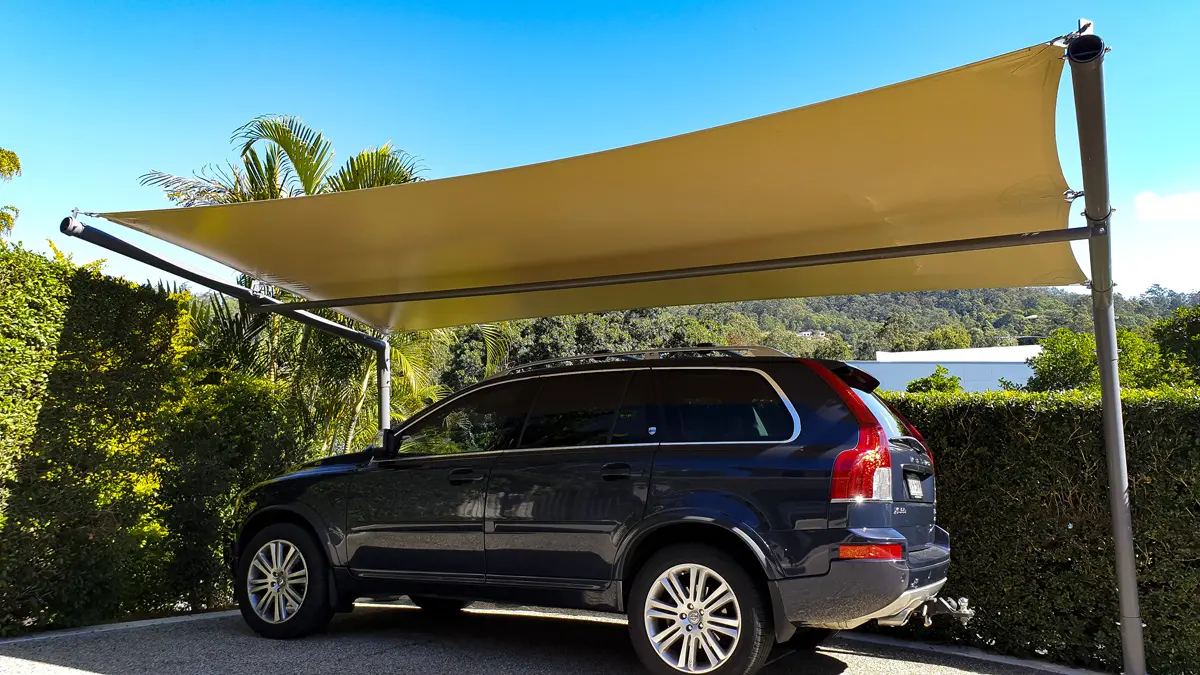
Why Choose Cantilever Over a Standard Four-Post?
There are five common reasons people choose cantilever in Cape Town:
Narrow driveways
A four-post shadeport needs corner posts at all four corners. On a driveway that is 3 metres wide or less, those posts eat into the space you actually need to manoeuvre. A cantilever puts all the posts on one side, the wall side, the boundary side, or whichever side is least in the way. The other side is completely open.
Garage door clearance
If your driveway runs up to a garage door, a four-post shadeport will have corner posts directly in front of the garage entrance. You will need to drive around them every time. A cantilever extends out from the side opposite the garage; your access to the garage stays unobstructed.
Tight against a wall or boundary
Properties with one side already against a wall, common in cluster homes and townhouses, cannot fit corner posts on the wall side without removing brickwork or running poles flush against the wall. Cantilever solves this by putting all poles on the open side.
Tight against a wall or boundary
Properties with one side already against a wall, common in cluster homes and townhouses, cannot fit corner posts on the wall side without removing brickwork or running poles flush against the wall. Cantilever solves this by putting all poles on the open side.
Aesthetics
A cantilever has a cleaner, more architectural look. The single row of posts and the floating roof are deliberately design-led. For homeowners who care about how the structure looks from the street or from inside the house, this matters.
Vehicle turning circle
Cantilever gives the largest possible turning circle for vehicles entering or leaving the bay. On commercial sites, school bus bays, and car wash installations, this is often the deciding factor.
Why Cantilever Costs More, and When It’s Worth It
Cantilever shadeports cost roughly 20–30% more than a four-post structure of the same size. We will tell you straight why, and when paying extra is worth it.
Why it costs more:
- Heavier-gauge poles. Cantilever poles carry the entire roof weight on one side. They need to be thicker — typically 89mm or 114mm diameter vs 76mm for four-post to resist the lever force without bending over time.
- Deeper, wider footings. Each pole must resist not just downward load but also a continuous overturning force. Footings go deeper (800–1,000mm vs 600mm), and the concrete diameter is wider.
- Reinforced cross-bracing. The roof frame needs additional bracing to transfer load back to the supported side without sagging at the cantilever edge over years of use.
- More steel overall. A cantilever uses more steel per square metre of cover than a four-post.
When it’s worth it:
- Your driveway, garage clearance, or boundary makes a four-post impractical
- You will use the bay daily and the access geometry matters
- The aesthetic is important to you
- The site has very high wind exposure and a four-post would still need upgraded specs anyway
When four-post makes more sense:
- You have plenty of space and no access issues
- Budget is tight
- The bay is for occasional use only
Cantilever Sizes and What They Fit
Standard cantilever configurations and what each fits comfortably:
Configuration
Standard size
Fits
Single cantilever
3.0m × 6.0m
One sedan, hatchback, or small SUV
Single cantilever (extended)
3.5m × 6.0m
One double-cab bakkie or large SUV
Double cantilever
6.0m × 6.0m
Two cars side by side
Double cantilever (extended)
6.5m × 6.5m
Two large SUVs or a car plus a 4×4
Triple cantilever
9.0m × 6.0m
Three cars side by side
Quadruple cantilever
12.0m × 6.0m
Four cars (commercial layouts)
Vehicle clearance heights (typical):
- Standard sedan: 1.5m clearance is sufficient
- SUV / double cab bakkie: 2.0m clearance recommended
- Caravan/boat on trailer: 2.5m–3.0m depending on the trailer
We measure your vehicle’s height at the site visit and design clearance accordingly. The cantilever overhang can be set higher than a standard four-post if needed; there is no roof frame at the access edge to limit clearance.
Important sizing note for cantilever:
The cantilever overhang has a structural maximum. We do not recommend cantilever overhangs beyond 6 metres for residential structures or 7 metres for commercial structures; beyond that, the structural engineering becomes complex and costs rise sharply. If you need to cover a wider area, a four-post or a hybrid structure is more practical.
Cantilever and Cape Town Wind
A cantilever shadeport behaves differently from a four-post in high wind. This matters in Cape Town.
The physics
When the Southeaster hits a cantilever roof from below, the uplift force is concentrated on the supported side. The poles on that side carry not just the roof weight but also uplift resistance across the full width. A poorly engineered cantilever in Bloubergstrand, Milnerton, or any high-exposure coastal site will eventually loosen at the footings or buckle at the cross-bracing.
How we account for the wind
Every cantilever installation we do west of the N1 or within 5km of the coast uses upgraded specifications as standard:
- Increased pole gauge (114mm minimum)
- Footings extended to 1,000mm depth, 450mm diameter
- Reinforced cross-bracing at the roof-to-pole junction
- Heavier-grade shade cloth with double-tensioned edges
These are not optional add-ons; they are baseline for any cantilever we install in those zones. We do not cut these specs to compete on price. A cantilever that fails in a Cape Town summer storm is not a saving; it is a write-off.
How a Cantilever Installation Works
Cantilever installations take slightly longer than four-post because of the heavier footings and additional curing time.
Step 1
Free site assessment
We assess the property, measure the space, check wind exposure, identify the supported side (typically the wall or boundary side), and confirm the cantilever direction. We discuss vehicle clearance, shade cloth options, and pole finish.
Step 2
Detailed quotation
You receive a detailed quote within 24 hours. It specifies pole gauge, footing depth, cantilever span, shade cloth type and colour, and the full price.
Step 3
Installation day 1
We mark and excavate the footings, set poles, and pour concrete. Cantilever footings need a full 36–48-hour cure before the roof load can be applied, longer than the 24 hours for a standard four-post — because the lever force on the concrete is higher.
Step 4
Installation day 2
We return once the concrete has cured fully. The cantilever frame and roof bracing go on first, then the shade cloth is tensioned and fixed. Final check of tension, alignment, and clearance.
Step 5
Handover
We walk through the structure, check fixings, and leave you with care notes. We provide a written warranty certificate covering both the shade cloth (10-year UV) and the structural workmanship (12 months).
Total elapsed time: 3–4 days from start to finish, with one day of installer presence on each of days 1 and 4.
Common Cantilever Applications in Cape Town
Townhouses and cluster homes
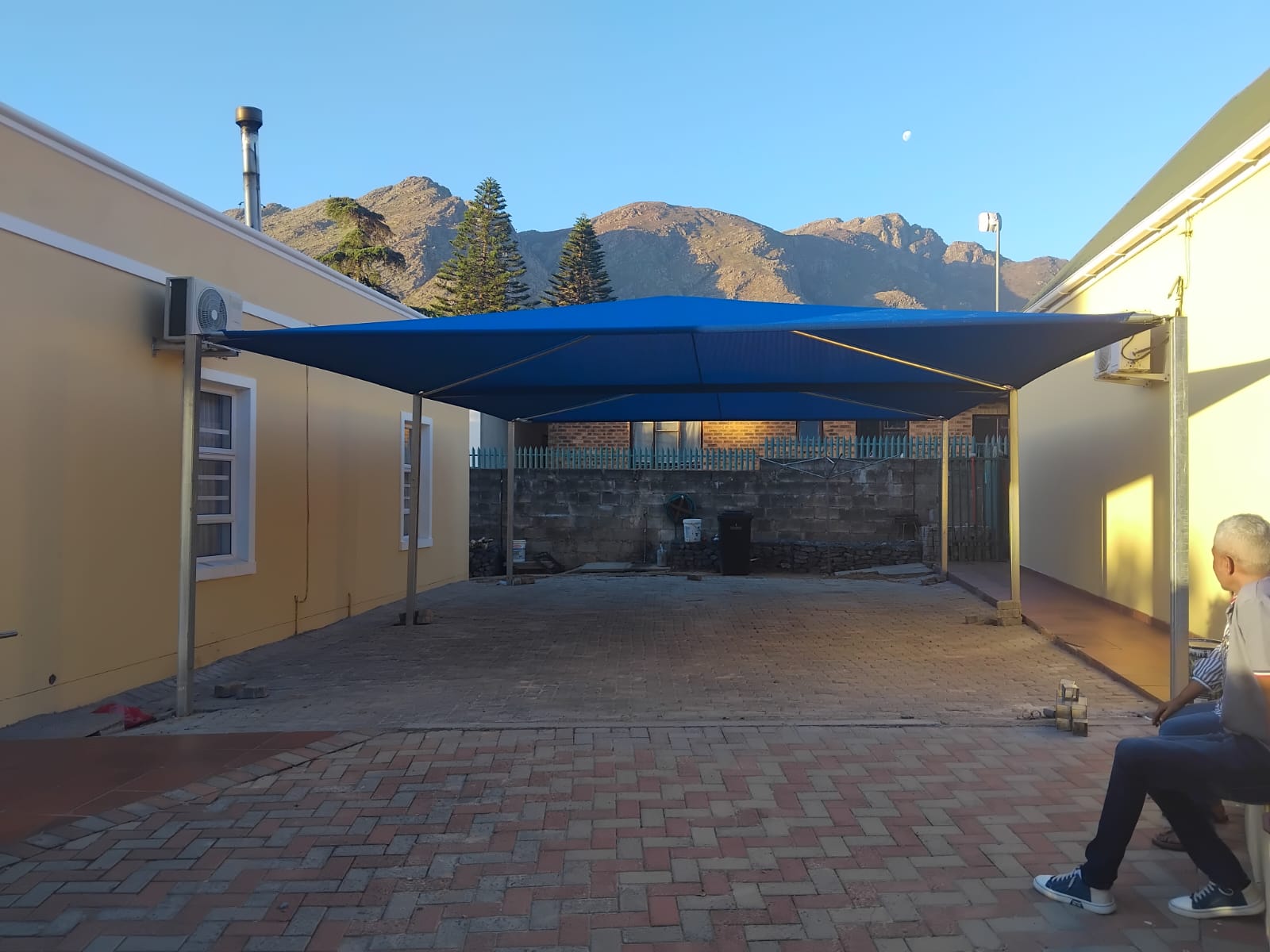
Limited space, boundary walls already in place, need to keep the bay accessible.
Properties with garages
A cantilever extending out from the side keeps the garage door entrance clear.
Sectional title parking bays
Most exclusive use parking bays are narrow with a wall on one side. A cantilever is often the only practical option.
Aesthetic-driven installations
Modern homes where a four-post would look heavy. Cantilever has a lighter, floating profile.
Commercial parking with vehicle flow
Office park bays, car wash bays, dealership display bays where vehicles need to enter and exit without weaving around posts.
School staff and bus bays
Wider clearance for buses, no posts to manoeuvre around during peak drop-off and pick-up.
Shadeport Projects in Cape Town
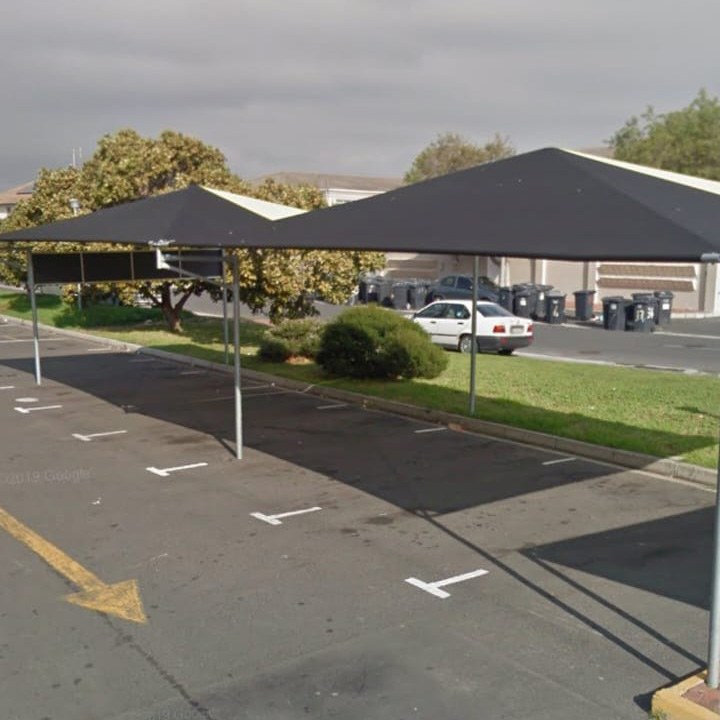
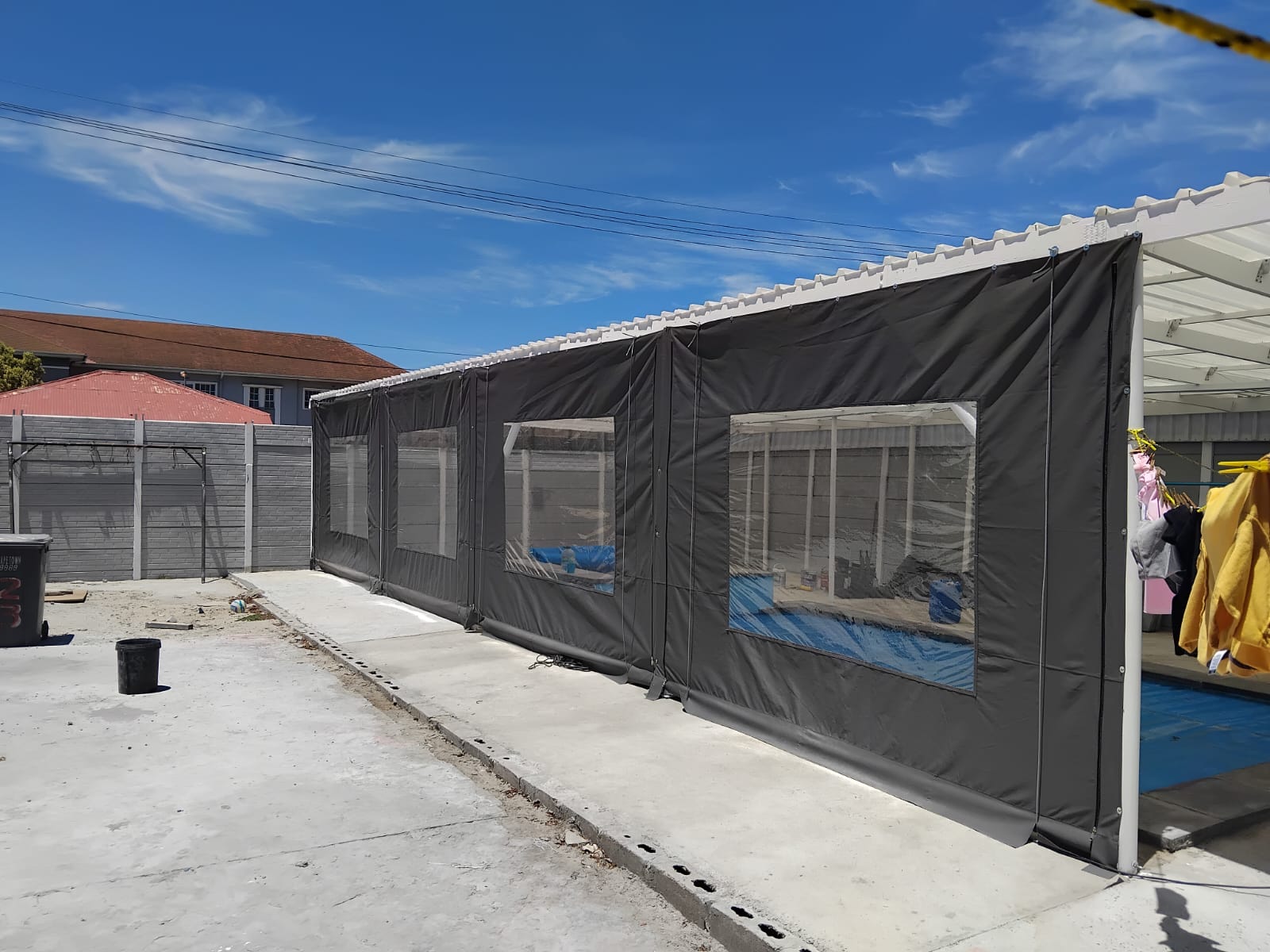
We Install Shadeports Across All of Cape Town
Northern Suburbs
Durbanville, Bellville, Brackenfell, Kraaifontein, Kuils River, Parow
Southern Suburbs
Constantia, Claremont, Rondebosch, Kenilworth, Tokai, Muizenberg
Atlantic Seaboard
Camps Bay, Sea Point, Hout Bay, Green Point
West Coast
Table View, Parklands, West Beach, Sunningdale, Bloubergstrand
Frequently Asked Questions about Cantilever Shadeports
Is a cantilever shadeport as strong as a four-post?
Yes, when properly engineered. A correctly built cantilever uses heavier-gauge poles, deeper footings, and reinforced bracing to handle the same load as a four-post, sometimes more. The strength does not come from having four posts; it comes from the structural specification. A cheap cantilever will fail because the specs were cut. A properly built cantilever will outlast a four-post in many cases because the heavier specs are baked in.
Will a shadeport match the look of my home?
It can. We carry shade cloth in a range of colours; black, charcoal, light grey, beige, green, and white are our most common. Poles can be powder-coated in a colour of your choice. We bring samples to the site visit and can match your home’s trim or render colour reasonably closely. A well-specced shadeport looks like a deliberate feature, not an add-on.
How much more does a cantilever cost than a four-post?
Typically 20–30% more for the same size. The extra cost covers heavier pole gauge, deeper footings with more concrete, and reinforced cross-bracing. In Cape Town’s high-wind coastal zones, the price gap narrows because four-post structures in those zones also need upgraded specs.
Can I get a cantilever shadeport in a narrow driveway?
This is one of the main reasons people choose cantilever. As long as one side (a wall, boundary, or fence line) can accommodate the support posts, the other side stays completely open. A driveway as narrow as 2.5 metres can take a cantilever; a four-post often cannot.
How wide can a cantilever overhang be?
We recommend cantilever overhangs up to 6 metres for residential and 7 metres for commercial structures. Beyond that, the structural engineering becomes complex, and costs rise sharply. For wider coverage, a four-post or hybrid structure is usually more practical.
Are cantilever shadeports safe in Cape Town’s wind?
A properly engineered cantilever is safe in Cape Town conditions. We use upgraded specifications as standard for any cantilever installed in high-wind zones, coastal areas, the Cape Flats, or sites west of the N1. Heavier pole gauge, deeper footings, reinforced bracing. This is non-negotiable for a cantilever in those zones. We do not cut these specs to lower the price.
Get a Free Cantilever Shadeport Quote
Send us a photo of your driveway or space, and we will come out for a free site visit. You will have a written quote within 24 hours.
 Chat with us