
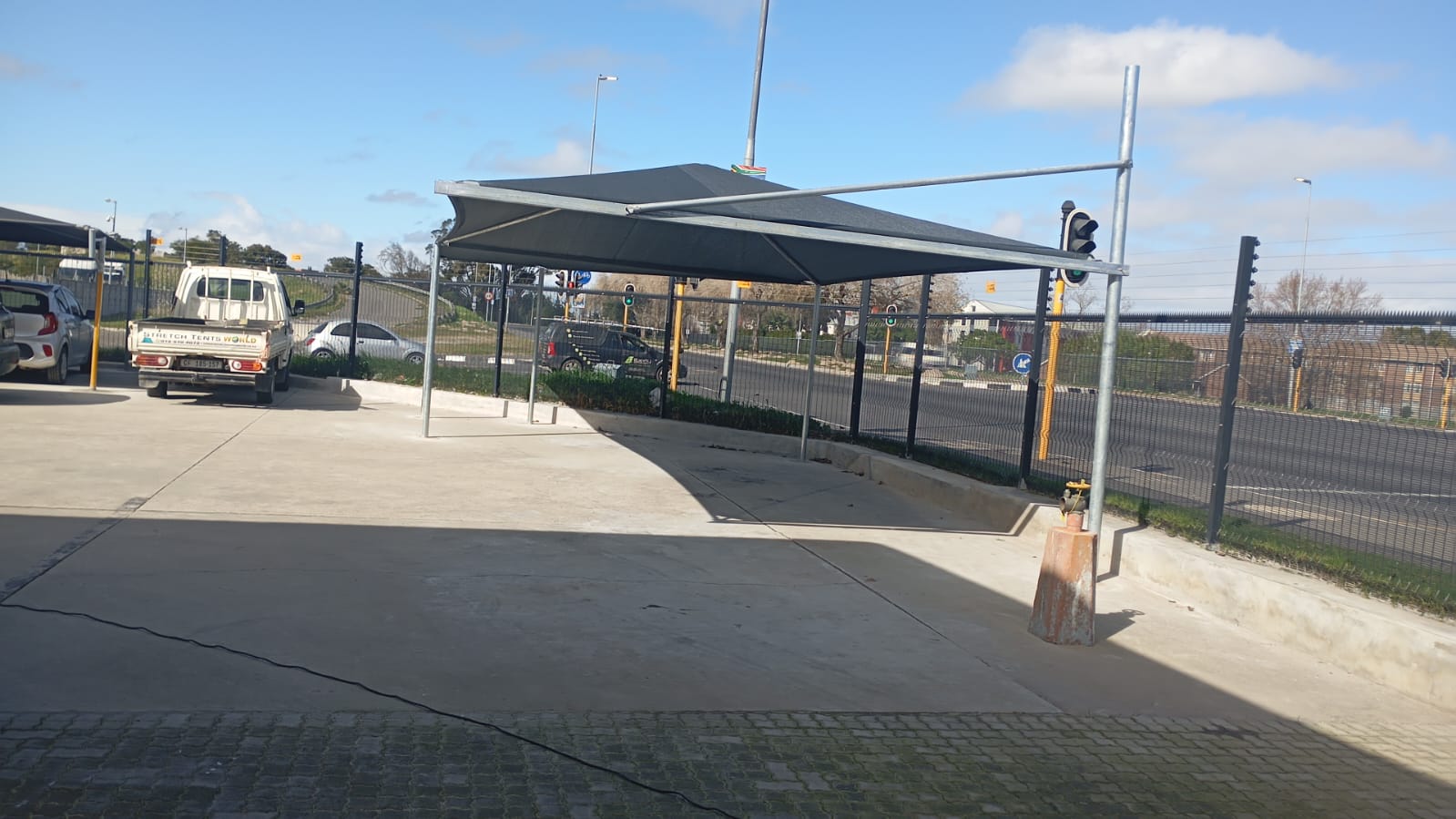
A well-built shadeport in Cape Town lasts 10 to 15 years as a structure. The shade cloth usually needs replacing before the frame does. We give a 5-year UV guarantee on our cloth, and once cloth is past about 8–10 years old or shows real UV damage, replacing it is almost always better than patching it. A poorly built shade port, with painted mild steel, shallow footings and cheap cloth, can start failing in its first few seasons.
The difference between those two outcomes rarely comes down to luck. It comes down to what the shadeport is made of, how it was installed, and how exposed your property is to Cape Town’s three hardest conditions: UV, wind and salt air.
How Long Each Part of a Shadeport Lasts
A shadeport doesn’t wear out all at once. Each part ages at its own pace, and knowing which part fails first tells you what you’ll actually be paying for down the line.
| Component | What to expect in Cape Town | What shortens it |
|---|---|---|
| Hot-dip galvanised steel frame | Built for a 10–15 year structural lifespan | Painted mild steel instead of galvanised; salt air near the coast |
| Concrete footings | Fail early only when set too shallow, the most common cause of shadeport failure in Cape Town | Footings shallower than 600mm; sandy ground |
| Shade cloth | 5-year UV guarantee; once past about 8–10 years or visibly UV-damaged, replacement beats patching | Low-grade cloth; wrong tension; high UV exposure |
| Fixings and tension webbing | Serviceable parts that loosen or wear under constant load | Plastic clips; non-stainless fixings near the coast |
Shade clothUV guarantee
Steel frameStructural lifespan
In practice, over a shadeport’s life you should expect to replace the cloth once and service the fixings, not replace the whole structure.
What Wears a Shadeport Out Faster in Cape Town
UV intensity
Mainly wears: ClothCape Town’s UV index regularly reaches very high to extreme levels (8–11+) in summer. UV breaks down the polymer in shade cloth, which fades, turns brittle and eventually tears. Cloth rated for milder conditions degrades faster here. Low-grade cloth can fade and tear within two to three seasons.
The Southeaster
Mainly wears: Cloth, fixings, footingsThe summer Southeaster regularly reaches 60–80 km/h, with gusts above 100 km/h on exposed sites. Wind turns small weaknesses into failures: a loose fixing becomes a flapping panel, and a shallow footing becomes a leaning pole. Cloth that’s too loose tears in the wind. Cloth that’s too tight overloads the joints and fixings. On exposed sites in Bloubergstrand, Milnerton, Parklands and the Cape Flats, a shadeport needs extra bracing and deeper footings to reach its full lifespan.
Salt air
Mainly wears: Steel, fixingsProperties within about 5km of the coast, including Sea Point, Camps Bay, Hout Bay, Strand and Gordon’s Bay, see much faster corrosion. Untreated steel can start corroding within months. That’s why hot-dip galvanised steel and stainless fixings matter far more at the coast than inland. On beachfront properties, waterproof PVC cloth usually holds up better than woven shade net, because salt spray speeds up UV breakdown in the cloth.
Sandy or shifting ground
Mainly wears: FootingsIn areas like Table View, Milnerton and Strand, sandy soil can shift around footings. If the poles weren’t set deep enough in the first place, the structure starts to lean long before the steel or cloth wears out.
Why Installation Quality Decides Most of the Lifespan
Most shadeport failures in Cape Town come down to three things: poor materials, shallow footings, or ignoring local conditions. All three are decided on installation day, and none of them are visible once the job is finished. When you compare quotes, these are the details that decide whether you get a few seasons or 15 years:
- Steel treatmentHot-dip galvanising is bonded into the steel, so it doesn’t peel, chip or crack the way paint does. Once paint lifts on mild steel, rust spreads quickly, especially near the coast.
- Footing depthPoles should be set in concrete at least 600mm deep, and deeper in sandy ground or on exposed sites. Shallow footings are the most common cause of shadeport failure in Cape Town.
- FixingsStainless steel fixings and reinforced webbing at the tension points, not plastic clips.
- Cloth grade and tensionUV-rated, high-density cloth, tensioned correctly for the site’s wind exposure.
That’s why the cheapest quote often costs more over time. A shadeport that needs a new frame after five years costs more than one that only needs new cloth after ten.
Signs Your Shadeport Is Wearing Out
Catching wear early is what separates a cheap repair from a replacement. Check for:
- Faded, brittle or thinning cloth, especially along edges and seams
- Sagging cloth that no longer holds its tension
- Small tears at the corners or fixing points
- Rust spots on poles, particularly at the base
- A leaning pole or a frame that moves when you push it, which usually means a footing has failed
- Loose, corroded or snapped fixings and webbing, especially after a storm
Rust near the coast and a leaning structure are the two to act on quickly. Both get worse fast, and both put the rest of the structure under strain.
How to Make Your Shadeport Last Longer
Simple maintenance goes a long way:
- Rinse the cloth with water after major storms to clear debris and salt.
- Check the tension after heavy wind.
- Inspect the pole bases. If rust is forming, treat it with a zinc-rich primer; every three to five years is a sensible interval.
- Deal with small tears early. A small tear in wind-exposed cloth grows quickly.
- Replace worn fixings before they fail. They’re cheap parts, and a failed fixing can tear the cloth or overload the frame.
Repair or Replace: How to Decide
When a shadeport starts showing its age, the decision usually comes down to the frame.
Repair makes sense when
- The frame is structurally sound, with poles plumb, joints tight and no rust that has eaten through the steel
- Only the shade cloth needs replacing
- The damage is limited to one section or component
- The shadeport is less than about 10–12 years old
Replacement makes more sense when
- Several poles show rust that has eaten through the steel, or have gone structurally weak
- The original frame is unprotected mild steel, which will keep corroding
- More than one footing has failed
- The structure is 15+ years old and has already needed several repairs
65–70%
If a repair quote comes to more than about 65–70% of the cost of a new installation, replacement is almost always the better financial decision.
New cloth on a sound frame is the most common repair we do. See our shadeport repair service for how we assess this on site.
What a Longer-Lasting Shadeport Costs
A properly built shadeport doesn’t have to be expensive. Our single shadeports start from R5,500 supplied and installed, and the full breakdown is in our guide to what a shadeport costs in Cape Town.
≈ R550 a year
A single shadeport from R5,500 over a 10-year structural life, before cloth replacement.
That’s why paying slightly more for galvanised steel and proper footings usually works out cheaper in the long run.
Shadeport Lifespan FAQs
How long does shade cloth last in Cape Town?
Our cloth carries a 5-year UV guarantee. Once cloth is past about 8–10 years old or visibly UV-damaged, replacing it is almost always better than patching. Low-grade cloth can fade and tear within two to three seasons.
Does a shadeport last longer inland than at the coast?
Generally, yes. Salt air within about 5km of the coast speeds up corrosion of steel and fixings, and beachfront salt spray also speeds up cloth breakdown. With hot-dip galvanised steel and stainless fixings, a coastal shadeport can still reach its full lifespan, but material choice matters much more there.
Does PVC cloth last longer than shade net?
On beachfront properties, waterproof PVC cloth is usually the better choice because it resists the combination of salt spray and UV better than woven shade net. Both types we install carry the same 5-year UV guarantee.
Can I replace just the cloth and keep the frame?
Yes, if the frame is structurally sound. It’s the most common shadeport repair, and much cheaper than a new structure.
What’s the most common reason shadeports fail early?
Shallow footings. Poles set less than about 500–600mm deep can sway, lean and eventually fail in high wind, well before the steel or cloth wears out.
5-year UV guarantee · 10–15 year structural lifespan
Get a Shadeport Built to Last
We build for Cape Town’s conditions from the start: hot-dip galvanised steel, footings set for your ground and wind exposure, stainless fixings and UV-rated cloth. Every job starts with a free site visit, where we check exposure, soil and access before quoting. See our shadeport installation in Cape Town.
 Chat with us