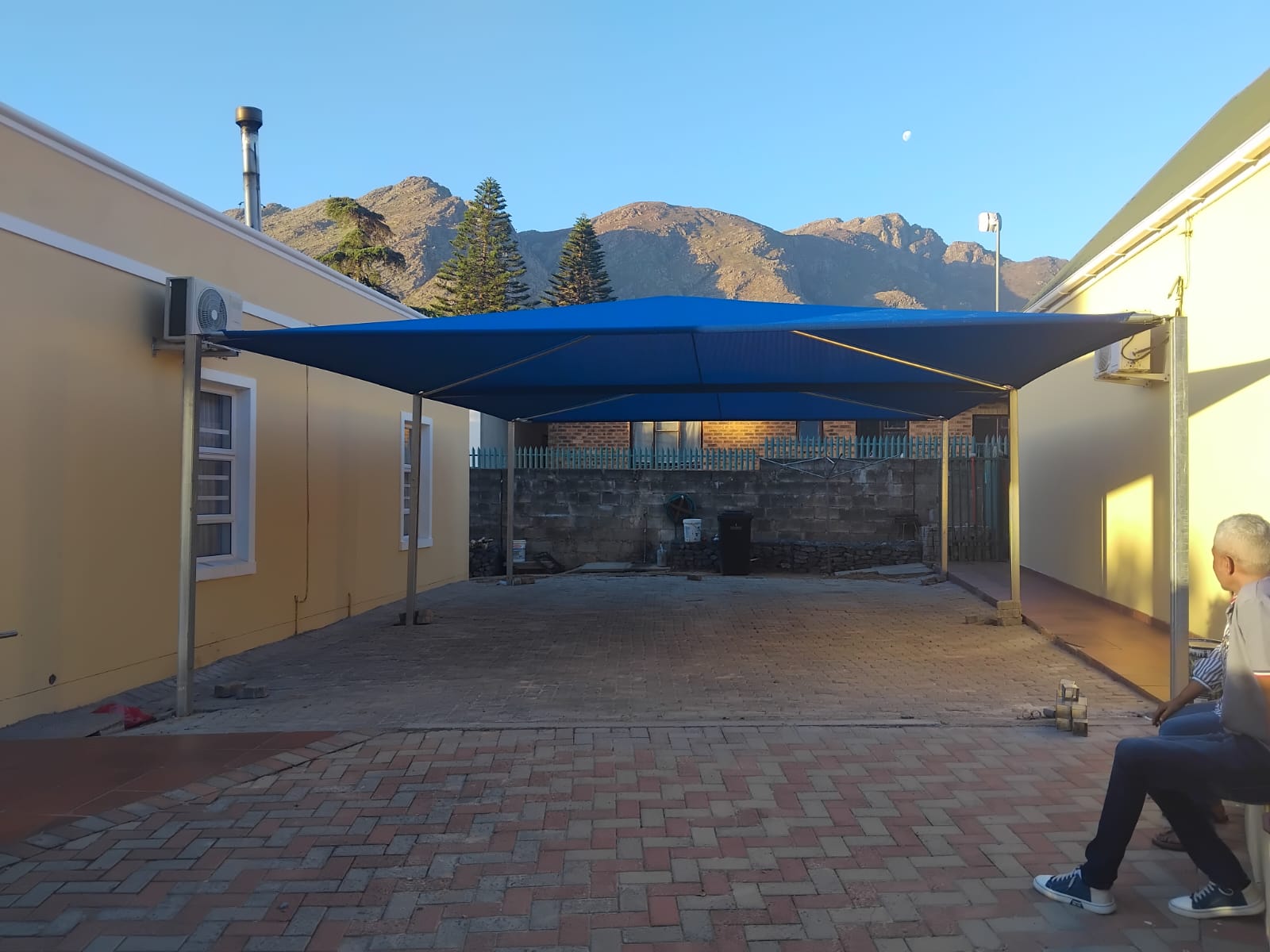
A single shadeport in Cape Town starts from R5,500 supplied and installed with us, a double from R6,500, a cantilever from R7,000, and triple or multi-bay commercial shadeports from R12,500. Every price includes installation. Published South African price guides put most single shadeports at roughly R7,500–R10,000 and doubles at R7,500–R13,000, and some of those figures are for the kit alone. What a shade port costs in Cape Town varies widely.
A “from” price is the simplest version of each structure on a straightforward site. What moves your final number is size, structure type, cloth, how exposed your property is to wind and salt, and what the ground looks like where the poles go. This guide covers each of those so you have a realistic figure in mind before anyone measures your driveway.
Shadeport Prices in Cape Town at a Glance
| Shadeport type | Standard size | Typical use | Starting price (supplied & installed) |
|---|---|---|---|
| Single | 3m × 6m | One car, standard driveway | from R5,500 |
| Double | 6m × 6m | Two cars side by side | from R6,500 |
| Cantilever | Sized to the driveway | Narrow driveways, or where posts would block doors or gates | from R7,000 |
| Triple / multi-bay | 9m × 6m and up | Three or more cars, complexes, small business parks | from R12,500 |
These are starting points, not fixed prices, and every one includes installation by our own crew. Every shadeport we install is measured and quoted for the actual site.
Why a Double Costs Only Slightly More Than a Single
The starting price for a double is only R1,000 more than for a single. That isn’t a discount. It’s how the costs work out.
A lot of what you pay for is fixed per job: the site visit, setting out, digging and concreting the footings, and the crew’s day on site. Going from one bay to two adds steel and cloth, but not a second set of all that fixed work. So if you have two cars, or think you might have two cars in a few years, the double is usually the better value per car. Get both priced before you decide.
What Pushes a Shadeport Price Up or Down
Size and number of bays
Price effect: Not linearMore bays means more steel, more cloth and more footings. Larger spans also need heavier sections to stay rigid in the wind, so cost doesn’t rise in a straight line with size. A long run of bays for a complex is quoted as its own design, not as several singles added together.
Cantilever vs. post-supported
Price effect: +20–30%A standard shadeport stands on posts at the front and back. A cantilever holds the canopy from one side only, so nothing stands in the way of car doors, gates or a narrow driveway. That clear front edge takes a heavier frame and deeper footings to carry the load, so a cantilever typically costs 20–30% more than a four-post shadeport of the same size. See our cantilever shadeport options for how they’re built.
PVC-coated cloth vs. shade net
Price effect: +R1,500–R2,500UV-rated shade net
Blocks sun and heat and lets air through. Sheds wind load well. It is not waterproof, and rain passes through.
PVC-coated cloth
Waterproof, with full rain cover. The upgrade adds roughly R1,500 to R2,500. As a solid surface it takes more wind load, which the frame has to be specified for.
If you mainly want to protect your paint and interior from sun, shade net is often enough. If you want to get in and out of the car dry in a Cape winter, PVC is the one to price.
Wind and salt exposure
Price effect: Heavier specA shadeport in Brackenfell and one in Bloubergstrand are not the same build. Cape Town’s Southeaster regularly exceeds 100 km/h, and coastal suburbs add salt air, which corrodes untreated steel and cheap fixings within a few seasons. On exposed and coastal sites we build to a heavier, marine-appropriate specification by default. That costs more at the start and far less than replacing a rusted or wind-damaged frame later.
Site conditions
Price effect: Assessed on visit- Whether footings go into soil, existing paving or concrete that has to be cut
- Slope, which affects post heights and levelling
- Access for the crew and materials
- Whether an old structure has to come down first
None of these are hidden extras. They’re the reason we don’t give a final number over the phone.
Sectional title and HOA requirements
Price effect: May limit optionsIf you’re in a complex, the trustees or HOA may specify the colour, cloth type or style so new structures match existing ones. That can rule out the cheapest combination. Check your conduct rules before you get quotes so you’re pricing a shadeport that will actually be approved.
What a Low Shadeport Quote Often Leaves Out
When two quotes for the “same” shadeport are thousands of rand apart, the difference is usually in things you can’t see once it’s installed. Before you compare prices, ask every installer these questions:
- How is the steel treated?Hot-dip galvanised steel resists rust for years. Painted mild steel can start showing rust within a few seasons near the coast.
- How are the poles set?Poles should be set in concrete footings sized for the wind load, not just dug in.
- What are the fixings made of?Stainless steel fixings don’t rust and stain the frame. Zinc-plated ones can.
- What’s the cloth’s UV rating?Our high-density cloth blocks at least 95% of UV. Lower-grade cloth fades and becomes brittle faster.
- Is it designed for the Southeaster?Ask how the frame and tensioning are specified for 100 km/h+ gusts.
- What exactly is guaranteed, and for how long?Get it in writing. We give a 5-year UV guarantee on the shade cloth and build for a 10–15 year structural lifespan.
A cheap quote that says yes to all six is a good quote. One that can’t answer them is cheap for a reason.
What a Shadeport Costs Over Its Lifespan
The purchase price is only part of the picture. The frame is the long-life part. Shade cloth is the part that eventually wears, which is why our UV guarantee on cloth (5 years) is separate from the structural lifespan (10–15 years).
Shade clothUV guarantee
Steel frameStructural lifespan
≈ R550 a year
A single shadeport from R5,500 over a 10-year structural life, before any cloth replacement.
When the cloth wears out, a sound frame only needs new cloth, not a new shadeport. If yours is already showing wear, a shadeport repair or re-cloth may be all it needs. That’s also why a slightly higher price for galvanised steel and proper footings usually works out cheaper per year.
Deposits and Payment: What to Check Before You Pay
Online reviews of Cape Town shade and carport companies include more than one story of a deposit paid and the job never finished. Whoever you use:
- Only pay a deposit against a written quote that states the price, the specification and an installation date.
- Ask who will actually do the installation: the company’s own crew or a subcontractor.
- Confirm the business has a real physical address and a working phone number.
We do our own installs with one dedicated 2–3 person crew, work from a real address in Fisantekraal, and put every quote in writing.
How to Get an Accurate Shadeport Price
A site visit turns a price range into your actual price. For our shadeport installation in Cape Town, the process is:
Free site visit
We measure, check the ground and access, and talk through cantilever vs. post-supported and PVC vs. shade net.
Written quote within 24 hours
The quote lists the specification, the price and what’s included.
Installed in 1–2 days
For most residential single and double shadeports. Cantilevers take 3–4 days.
To speed things up when you contact us, have these ready: how many cars you want to cover, a photo of the driveway or parking area, whether you’re in a sectional title complex, and whether rain cover (PVC) matters to you.
Shadeport Cost FAQs
Do shadeport prices include installation?
Ours do. Every price and quote covers supply and installation by our own crew, and we don’t sell kit-only shadeports. When you compare prices online, check whether a figure is for the kit alone or installed, because installation can add a meaningful share of the total.
Is the R5,500 starting price realistic?
Yes, for the simplest single shadeport on a straightforward site. The price rises with size, cantilever design, PVC cloth, coastal-grade specification or difficult ground. The site visit tells you which of those apply, and the written quote shows the difference.
Do I need council approval for a shadeport?
Yes. In the City of Cape Town, carports and shadeports need the City’s approval before you build, because the City lists carports among the minor works that need building plan approval. Up to 40m², a shadeport counts as minor building work, which means the City may relax the plan requirements in writing, but you still apply first. In a sectional title complex, you’ll also need trustee or HOA approval.
How long does installation take?
Most residential single and double shadeports take 1–2 days once the quote is accepted. Cantilevers take 3–4 days from start to finish, because their heavier footings need longer to cure before the roof goes on. Larger multi-bay jobs are scheduled as part of the quote.
Is shade net or PVC cheaper in the long run?
Shade net is usually cheaper to buy and takes less wind load. PVC costs more but gives full rain cover. Which is cheaper over time depends on what you need the shadeport to do. If you’d only use the rain cover occasionally, shade net is often the better value.
Why do Cape Town shadeport prices vary so much between companies?
Most of the gap comes from specification (galvanised vs. painted steel, footing depth, fixings, cloth grade) and from whether the quote was made after seeing the site. Compare quotes line by line, not just on the total.
Free site visit · Cape Town, Helderberg & Winelands
Get Your Actual Shadeport Price
A shadeport in Cape Town starts from R5,500 supplied and installed for a single, and most homeowners end up somewhere above that depending on size, structure type, cloth and exposure. The quickest way to get your actual number is a free site visit and a written quote within 24 hours.
 Chat with us